
The UK OER Programme1 was run by the UK Higher Education Academy and JISC, with funding from HEFCE, between 2009 and 2012. The Programme built on previous work undertaken by JISC, and the expertise of the JISC CETIS Innovation Support Centre. This book explores the technical issues surfaced by the programme and the JISC CETIS OER Technical Support Project during this three year period.
JISC Programmes 2002-2009
JISC has a long history in developing and promoting innovative technical approaches to learning resource management and discovery that can be traced back to programmes such as Exchange for Learning2 (X4L, 2002 – 2006), which focused on the creation of reusable learning resources, and tools to facilitate their production and management; Re-purposing and Re-use of Digital University-level Content3 (RePRODUCE, 2008 – 2009) which encouraged the re-use of high quality externally produced materials and facilitated the transfer of learning content between institutions; and the Digital Repositories4 (2005 – 2007) and Repositories Preservation Programmes5 (2006 – 2009) which aimed to establish technical infrastructure within institutions and across the sector. (For an overview of learning technology initiatives funded by various bodies across UK educational sectors prior to 2002, see Open Educational Resources – a historical and international perspective by David Kernohan and Amber Thomas, 20126).
These programmes were informed by a strategic and technical vision that was expressed through initiatives including the e-Learning Framework7, the e-Framework8, the Information Environment Technical Architecture9 and the Digital Repositories Roadmap10. The Information Environment Architecture for example sought to “specify a set of standards and protocols intended to support the development and delivery of an integrated set of networked services that allowed the end-user to discover, access, use and publish digital and physical resources as part of their learning and research activities.”11
For example the aims of the 2002 Exchange for Learning (X4L) Programme were to:
- “use and develop the best available tools to explore whether repurposing content can become a popular, sustainable way of producing e-learning materials for the future;
- increase the numbers of people in institutions with the necessary skills to repurpose learning objects;
- expose and begin to tackle the challenges associated with repurposing learning objects; and
- begin to populate a national repository with learning materials as well as case studies and exemplars showing how these have been achieved.” 12
In order to achieve these aims the programme gave projects a strong steer to use educational technology interoperability standards such as IMS QTI13, IMS Content Packaging14, ADL SCORM15 and IEEE LOM16. CETIS developed a mandatory application profile of the IEEE LOM for the programme and formal subject classification vocabularies were identified including JACS17 and the Dewey Decimal Classification System18. Projects were strongly recommended to deposit their content in the national Jorum repository19 (also developed as part of the X4L Programme), institutions were required to sign formal licence agreements, and access to content deposited content in Jorum was restricted to UK F/HE institutions only.
An OER timeline20 mapping these initiatives was created for JISC CETIS.
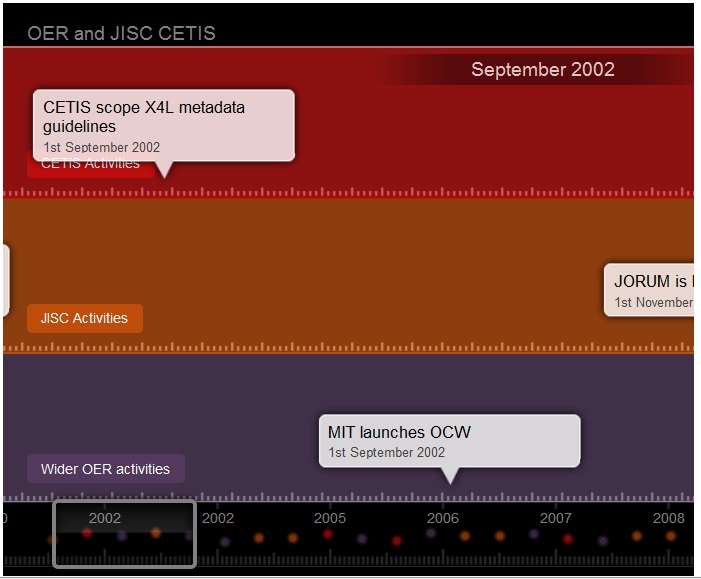
OER Timeline produced by Lou McGill for CETIS Other Voices Blog 2012
These early programmes and initiatives met with varying degrees of success across the different sectors of the UK F/HE community. While the X4L programme defined the way that JISC and partners would deliver programmes aimed at systemic cultural change, the programme evaluation was clear that significant barriers around the online sharing and reuse of educational resources remained:
“X4L has demonstrated that the principal benefits of reuse and repurposing are generally understood and accepted in the communities involved in the programme. However, the concept of reusable learning objects is still not proven or generally accepted in mainstream practice across the FE and HE sectors. That said, X4L has identified and explored many of the key barriers to reuse and repurposing, including the pressures of time and resource constraints on staff, concerns about professional integrity and academic independence, cultural resistance to sharing, and tensions between community collaboration and institutional competition.”21
In addition, while there has been considerable progress since 2000 in developing open access institutional repositories and promoting the deposit of scholarly works, journal papers and e-theses22 ; there was arguably less success in using repositories to support and facilitate access to teaching and learning materials. Indeed one of the final conclusions of the 2006 – 2009 Repositories and Preservation Programme Advisory Group, which advised the JISC repositories programmes, was that teaching and learning resources had not been served well by the debate about institutional repositories seeking to cover both open access to research outputs and management of teaching and learning materials as the issues relating to their use and management are fundamentally different.
Furthermore, in 2009 the findings of the RePRODUCE Programme suggested that projects had significantly underestimated the difficulty of finding high quality teaching and learning materials that were suitable for copyright clearance and reuse.
From 2006 onwards, JISC CETIS was tasked with providing the technical framework and guidelines for programmes and initiatives within the e-learning domain. This involved the identification of systems, technologies, open standards and vocabularies that programmes mandated and projects were required to implement.
Evolution of OER
The term Open Educational Resources (OER) was first introduced at a conference hosted by UNESCO in 200023 and was promoted in the context of providing free access to educational resources on a global scale. There are many subtly varying definitions of OER, however on a basic level open educational resources may be described as freely available digital materials released under open licence, that can be used and re-purposed for teaching, learning, and research.
In 2001, while JISC were scoping the X4L Programme, the Hewlett foundation were supporting MIT in launching the OpenCourseWare (OCW) movement which proposed to make almost all of its 2,000 courses, in the form of lecture notes, problem sets, syllabuses, exams, simulations and video lectures, freely available to the general public on the open web. Faculty chairman Steve Lerman told the New York Times:
“Selling content for profit, or trying in some ways to commercialize one of the core intellectual activities of the university […] seemed less attractive to people at a deep level than finding ways to disseminate it as broadly as possible.”24
This position was amplified by the then MIT President, Professor Charles Vest:
“This is a natural fit to what the Web is really all about, […] We’ve learned this lesson over and over again. You can’t have tight, closed-up systems. We’ve tried to open up software infrastructure in a variety of ways and that’s what unleashed the creativity of software developers; I think the same thing can happen in education.”
That same year, the Center for the Public Domain25 provided support for Creative Commons, a new nonprofit organization that set out to enable the sharing and use of creativity and knowledge through free legal tools. In December 2002 Creative Commons launched their first set of free copyright licenses26. These copyright licenses provided a simple, standardized way to allow the public permission to share and use creative works.
Three years later in 2005 the Open CourseWare Consortium (OCWC)27 was founded with the support of the William and Flora Hewlett foundation28. OCWC drew together a number of other institutions that had followed the MIT OCWC model. Early members included many North American institutions, but also consortia from China and Japan.
The first large scale OER initiatives in the UK were launched in 2006 and 2007 respectively. In October 2006 the Open University launched OpenLearn29, which aimed to make a selection of OU materials available worldwide for free use and to build communities of learners and educators around the content using a range of tools and strategies. OpenLearn provided not only a collection of free course material but also a set of tools to help authors publish and support collaborative learning communities.
In September 2007 the University of Nottingham developed U-Now30 a collection of open educational materials openly licensed for anyone to use. These materials ranged from complete modules to smaller-scale learning objectives, and highlighted a range of teaching and learning activities from across the institution.
The following year in 2008, CETIS published a whitepaper on global OER developments, Open Educational Resources – Opportunities and Challenges for Higher Education31. This influential paper covered current and future trends in OER development and aimed to stimulate debate and develop a forward looking research agenda. Topics covered included a discussion of the conceptual and contextual issues of open educational resources, a review of current OER initiatives, and discussion of emerging trends, with respect to future research and activities.
At the same time JISC had also commissioned a report on improving the evidence base in support of sharing learning materials. The Good Intentions report32 articulated the advantages and imperatives for sharing learning resources using evidence from the UK and elsewhere. It also identified a number of compelling business cases and developed a set of variations as a result of studying a range of business models.
The UK OER Programme
There were three phases to the UK OER Programme, described collectively here as the Programme. Each phase was planned in response to emerging priorities from the projects, so it shifted its focus over time.
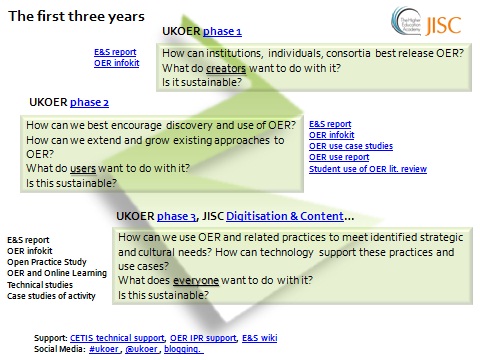
Three years of UKOER , David Kernohan, JISC 2012
OER Phase 1 Pilot Programme
In response to these global developments and national education policy drivers across the UK, HEFCE provided £5.7 million to JISC and the Higher Education Academy in 2009 to launch the first UK Open Educational Resources Programme33. This Pilot Programme, one of the first national OER initiatives in the world, ran from April 2009 – April 2010 and funded projects to make a significant amount of existing learning resources freely available online, licensed in such a way to enable them to be used and repurposed worldwide. The metaphor commonly used while the programme was being scoped was of “turning on the tap” to get the largest volume of open educational resources out into the public domain. In addition to simply releasing resources, projects were also expected to demonstrate a long term commitment to the release of open educational resources (OER) and to work towards the sustainability of long term open educational resource release via the adoption of appropriate business models. Where possible, projects were encouraged to work towards the modification of institutional policies and processes, with the aim of making OER release an expected part of the educational resources creation cycle. Funding was allocated to 29 individual, institutional and subject focused projects.
UK OER technical guidance
As a part of the UK OER Pilot Programme, JISC also provided support, advice and guidance on all aspects of open educational resource production and dissemination. This included guidance on issues around licensing and intellectual property rights, technology and standards.
In keeping with the experimental nature of the Pilot Programme, and in contrast to previous content creation programmes which mandated the use of specific technologies and standards, CETIS recommended that JISC adopt an “anything goes” approach to the programme. Rather than identifying specific applications, technical models, standards, application profiles and vocabularies, CETIS advocated that the OER Pilot Programme should adopt an open approach to the use of technology and standards34. Projects were allowed to release any kind of content, in any format, anywhere. Although projects were encouraged to use open standards where possible, proprietary formats were also acceptable. CETIS advised projects on the type of information they should record about their resources (e.g. title, author, owner, contributor, date, URL, file format, name and size) but not how to go about recording it. There was no programme specific metadata application profile and no formal metadata standard or vocabularies were recommended. The only mandatory metadata that projects were directed to record was the programme tag – ukoer. Projects were also given free rein to use any dissemination platform they chose provided that the content was freely available and released under an open licence. In addition, projects also had to represent their resources in JorumOpen either by linking or through direct deposit with all resources represented in JorumOpen being freely available worldwide and released under Creative Commons licences.
Rather than a radical shift in policy, this approach to technology and standards should be regarded as a reflection of a gradual development in policy, licensing and technology right across the web. These developments are illustrated by the advent of the social web, the appearance of media specific dissemination platforms such as slideshare, YouTube, flickr, iTunesU, interaction through RESTful APIs, OpenID, OAuth and other web-wide technologies, along with increasing acceptance of Creative Commons licenses. As a result, there had been a movement away from the development of centralised education specific tools and services, and towards the integration of institutional systems with applications and services scattered across the web. Furthermore, there was been growing awareness of the importance of the web itself as a technical architecture as opposed to a simple interface or delivery platform.
It was hoped that this approach would also provide an opportunity for authentic technical practice to emerge and for pertinent technology issues and problem areas to surface. This open approach to technology and standards and supporting technical diversity generated considerable interest from agencies outwith the UK including as ADL35 and OCWC.
In 2010 and 2011 HEFCE released funding for two further phases of the UK OER Programme and this open approach to systems, technology and standards was deemed to be sufficiently successful to underpin these new programmes.
OER Phase 2 Programme
The £5 million OER Phase 2 Programme which ran from August 2010 to August 2011 focused on three activity areas: release, use and discovery of OER36. 23 individual projects were funded and additional reports were commissioned on a range of topics including: patterns of behaviour around the use and reuse of OER and the impact of these behaviours on teaching and learning strategies from institutional, tutor and student perspectives; reflective case studies into the way open educational resources are used in a variety of contexts, including seminars, lectures and virtual learning environments; and tracking the use of materials released by pilot phase projects. The six “collections” projects were of particular interest as they aimed to use innovative technology approaches to bring together dynamic thematic collections of open educational resources from a range of sources worldwide.
Technical Mini Projects and Data Analysis and Visualisation Project
Underpinning the main funded programme, JISC were also focusing on wider digital infrastructure directions to support open educational resources and identifying specific technical interventions for potential funding. In this context a series of additional small projects were commissioned through CETIS to explore specific technical issues. These included the OER Technical Mini-Projects, awarded to the University of Newcastle in the UK (OER Bookmarking)37 and MIT in the US (CaPRéT – Cut and Paste Reuse Tracking)38, and the innovative OER data analysis and visualisation project39. The visualisation project was successful in documenting workflows for extracting data using different techniques including consuming linked data in Google Spreadsheets and harvesting OAI-PMH records using Google Refine. Outputs also included methods for cleaning data and reconciling it with other datasets. This included resolving tracking data from the CaPRéT OER Technical Mini-Project and examining social share statics of Jorum ‘ukoer’ records.
OER Phase 3 Programme
The third phase of the OER Programme which ran from October 2011 – October 2012 covered a variety of themes and produced a wide range of outputs40. Themes included the use of OER approaches to work towards particular strategic, policy and societal goals; support for institutional change; and the evolution of institutional policy to the support of the use, development and cultural acceptance of OER as part of everyday educational practice.
Rapid Innovation
Building on the experience of the CETIS Technical Mini-Projects, JISC also identified a number of areas where there were opportunities to enhance the digital infrastructure to support open content in education by funding small short projects producing technical solutions41.
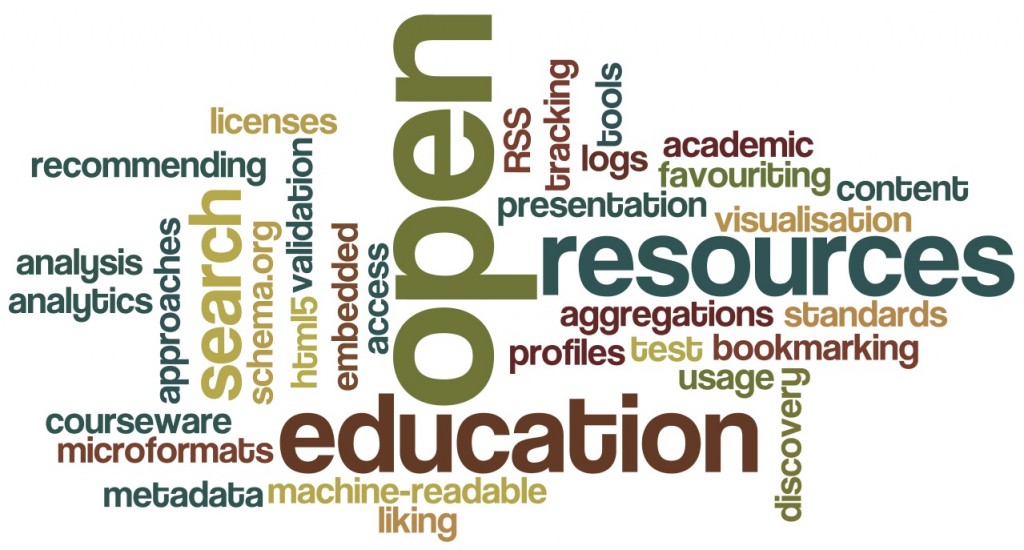
Thomas, A., (2011). Wordcloud of the Call for OER Rapid Innovation Projects, produced using wordle.net
An open call for project based at Universities and Colleges was launched and 15 short technical rapid innovation projects were funded, covering issues as diverse as linked data infrastructure for OER, sharing paradata across widget stores, increasing OER discoverability by improving keyword metadata via automatic speech to text transcription and the use of BuddyPress as an institutional academic profile management tool42.
Sister Content Programme
Another JISC programme which approached OER from a somewhat different angle was the £5.4 million Content Programme, running from 2011 – 2013. This programme funded 23 projects in three different strands focusing on mass digitisation, clustering of existing digital content and digitisation for open educational resources. The aim of the digitisation for OER strand43 is to release digitised educational content suitably licenced for use and re-use on an open access basis, and embed it within teaching and learning. Projects were encouraged to place particular emphasis on innovative approaches to the creation and delivery of digital content by working in partnership within and outside the educational sector to maximising the reach and impact of the content created.
Focus of the UK OER Technical Support Project at JISC CETIS
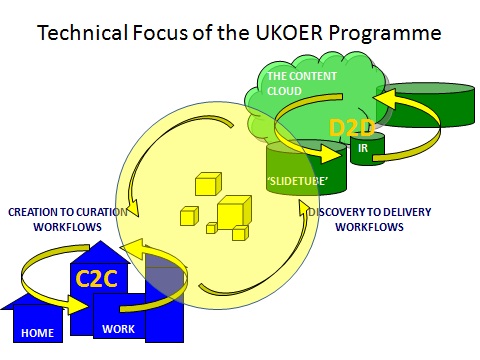
Thomas, A (2009) Technical Focus Diagram of the UK OER Programme
In scoping the OER Programme it became apparent that the biggest technical challenges would be in the way that content was made available on the web. Whilst it sounds obvious how an OER creator can just “put it online”, there are many choices to be made if release is to contribute to a healthy ecosystem of open content. In describing these issues, the authors of this book used the analogy of releasing OERs “into the wild” to express the mindset required to understand this evolving space.
The following chapters focus on technical issues that the UK OER Programme surfaced in this space, explores their relevance, the approach the Programme took, and where possible, the authors look to future directions.
- JISC Exchange for Learning Programme http://www.jisc.ac.uk/whatwedo/programmes/x4l.aspx a, b
- Re-purposing and Re-use of Digital University-level Content Programme, RePRODUCE, http://www.jisc.ac.uk/whatwedo/programmes/elearningcapital/reproduce.aspx a, b
- Digital Repositories Programme, http://www.jisc.ac.uk/whatwedo/programmes/digitalrepositories2005.aspx a, b
- Repositories Preservation Programmes http://www.jisc.ac.uk/whatwedo/programmes/reppres.aspx a, b
- Repositories Preservation Programmes http://www.jisc.ac.uk/whatwedo/programmes/reppres.aspx a, b
- Kernohan, D. and Thomas, A. (2012) Open Educational Resources – a historical perspective. http://repository.jisc.ac.uk/4915/a, b
- E-Learning Framework, http://www.elframework.org a, b
- E-Framework, http://www.e-framework.org/ a, b
- JISC Information Environment Technical Architecture http://www.jisc.ac.uk/whatwedo/themes/informationenvironment/iearchitecture.aspx a, b
- Digital Repositories Roadmap, http://www.jisc.ac.uk/whatwedo/themes/informationenvironment/reproadmaprev.aspx a, b
- JISC Information Environment Technical Architecture http://www.jisc.ac.uk/whatwedo/themes/informationenvironment/iearchitecture.aspx a, b
- Exchange for Learning Programme, X4L, http://www.jisc.ac.uk/whatwedo/programmes/x4l.aspx a, b
- IMS Question and Test Interoperability, http://www.imsglobal.org/question/ a, b
- IMS Content Packaging Specification, http://www.imsglobal.org/content/packaging/index.html ^
- Advanced Distributed Learning Sharable Content Object Reference Model, http://www.adlnet.gov/capabilities/scorm ^
- IEEE Standard for Learning Object Metadata, 1484.12.1, http://standards.ieee.org/findstds/standard/1484.12.1-2002.html ^
- HESA Joint Academic Coding System, http://www.hesa.ac.uk/index.php?option=com_content&task=view&id=158&Itemid=233 ^
- OCLC Dewey Decimal Classification System, http://www.oclc.org/dewey/ a, b
- Jorum, http://www.jorum.ac.uk ^
- OER Timeline http://blogs.cetis.ac.uk/othervoices/2012/02/13/open-educational-resources-timeline/ a, b, c
- Exchange for Learning Programme, X4L, http://www.jisc.ac.uk/whatwedo/programmes/x4l.aspx a, b, c
- see Jacobs, Neil and Thomas, Amber and McGregor , A (2008) Institutional Repositories in the UK: the JISC approach. Library Trends , 57 (2). pp. 124-141. ISSN 1559-0682 http://ie-repository.jisc.ac.uk/312 a, b
- REFERENCE TO UNESCO 2000 EVENT TO BE ADDED a, b, c
- New York Times http://www.nytimes.com/2001/04/04/us/auditing-classes-at-mit-on-the-web-and-free.html a, b, c
- Center for the Public Domain http://www.law.duke.edu/cspd/ a, b, c
- Creative Commons Licenses http://creativecommons.org/licenses a, b
- Open CourseWare Consortium OCWC http://www.ocwconsortium.org a, b, c
- William and Flora Hewlett Foundation http://www.hewlett.org/ a, b, c
- UK Open University OpenLearn http://www.open.edu/openlearn a, b, c
- University of Nottingham U-Now http://unow.nottingham.ac.uk/ a, b
- Open Educational Resources – Opportunities and Challenges for Higher Education http://wiki.cetis.ac.uk/images/0/0b/OER_Briefing_Paper.pdf a, b
- Good Intentions http://ie-repository.jisc.ac.uk/265/ a, b
- UK OER Programme Phase 1 (Pilot) http://www.jisc.ac.uk/whatwedo/programmes/elearning/oer.aspx a, b
- CETIS blog post: technical requirements http://blogs.cetis.ac.uk/lmc/2009/02/03/oer-programme-technical-requirements/ a, b
- ADL http://www.adlnet.org a, b
- UK OER Programme Phase Two http://www.jisc.ac.uk/whatwedo/programmes/elearning/oer2.aspx a, b
- FavOERite Project https://learning-maps.ncl.ac.uk/oer/ a, b
- CaPReT project http://capret.mitoeit.org/ a, b
- Visualising UK OER Project http://mashe.hawksey.info/2012/02/oer-visualisation-project-fin-day-40-5 a, b
- UK OER Programme Phase Three http://www.jisc.ac.uk/whatwedo/programmes/ukoer3.aspx a, b
- UK OER Rapid Innovation Strand http://infteam.jiscinvolve.org/wp/2011/11/29/oerri/ a, b, c
- Digital Infrastructure for Learning Materials Update July 2012 http://infteam.jiscinvolve.org/wp/2012/07/30/digi_inf_lm/ a, b
- Content Programme: Digitisation for OER Strand http://www.jisc.ac.uk/whatwedo/programmes/digitisation/content2011_2013/Strand%20A.aspx ^
